

What drives Americans to leave home and settle elsewhere? That question has been on my mind for many years. This series, Leaving America, seeks to uncover the multitude of reasons and lessons learned—beginning with Americans in and around Paris. Become a paid subscriber to access this newsletter’s archives.

For the last edition of this series for 2025 (more than a year after I started it!), I’m thrilled to speak with Farah Alimi. The Damascus-born, Paris-based artist ultimately left the United States for a reason that hasn’t yet been discussed here: to inch closer to her homeland. I first met Farah at Sobremesa, a wonderful wine bar in the 18th arrondissement that has regularly hosted her friend Shan Rachel Jiang as a chef in residence. Then, I kept running into her at Paramaz, a leather goods workshop-coffee shop-boutique we both love. Today, she joins me here to offer her story of leaving the U.S.
Where was the last place you lived in the U.S.?
Greenpoint, New York
Did you intend to leave permanently or was the move temporary?
I always knew, deep down, that New York was never meant to be my final destination. As painful as it was to leave, I understood when the moment arrived that it was time. The decision didn’t come all at once. I needed to test the waters first, to breathe somewhere new. Marseille was that threshold. I had visited the south once before, and my last stop was Marseille. The moment I stepped into its streets, tears slid down my cheeks, it was an indescribable feeling, as though I were visiting Damascus. I felt at home. The chaos, the humbleness of the city, it all resonated with me. I fell in love right then and there and promised myself I would return and stay for a while.
At the time, in 2016, Damascus, like the rest of Syria, was in a heartbreakingly fragile state, so the closest and most familiar city for me was Marseille. I was grateful to have found such a place. It felt like a gift, a moment that taught me patience and prepared me for the time I would eventually return to my birth city. Even now, I can still feel the quiet weight of that experience and how profoundly it shaped me. I knew I had to be in the south before making my way to Paris, to inch closer to home. That, more than anything else, was the reason.
Was there a pivotal moment when you knew your life would be best pursued elsewhere?
Yes, absolutely. I needed to live, to truly enjoy my time, instead of constantly working and hustling while life rushed past me. I was craving a life of quality. I didn’t fully know what I was stepping into then, but I chose to go for it anyway.
What sort of financial consideration did the move require, even if as a student initially? Does one need a plump savings account to make this work?
I was privileged to have had steady work that allowed me to save a solid amount of money before making my big move. Before fully committing to the decision, I took two important steps. I spent three months in Marseille during the holidays, from Thanksgiving through mid-January, to see if I was strong enough to handle being completely on my own, without family. I also took time to understand the financial reality of Europe, which was, and still is very different from New York. In many ways, life here is far more affordable.
Prior to COVID, I began working in wardrobe for film and television productions in Marseille, primarily on American projects. I continued working in wardrobe there until late 2021, after leaving fashion and New York behind, when I was still figuring out my direction. What eventually brought me to Paris was a job—ironically, a show that somehow connected back to fashion: The New Look, about Christian Dior, Coco Chanel, and Dior’s sister Catherine, a resistance fighter. I owe so much to Allyx Seaman, Thomas McCarthy, Rae Baron, and Karen Miller Serreau, whose guidance and support helped make a career like this possible for me.
At what age did you leave? Looking back, was that too soon or too late?
I left at 27, nearly nine years ago. It was the right time to make the move, and I wouldn’t have had it any other way. I’m truly thankful.
When did you know you'd made the right [or wrong] call?
Despite missing my family and friends, and despite how difficult the first two years were, I quickly realized it was the right call. I was learning a new language, discovering a new culture, and living in an almost 40m² apartment with rent so low it would be impossible in the States, all just a short walk from the Mediterranean. Even then, I was a happy camper, always grateful. And of course, moving to Paris after four years was the cherry on top. I moved for work, and I couldn’t have been happier to start a new chapter in a city I had always imagined would be a part of my life. Funny how life works.
What does Paris offer you that your native home couldn’t and, perhaps, still can’t?
I was just thinking about this a few weeks ago. Paris is charming in many ways, but one charm I especially appreciate is how, no matter how fast-paced the city can feel, it always makes time to pause and relax. It nudges you to slow down and savor life. At first, I found it a bit strange, like the unhurried pace at restaurants, but then I realized it was for my own good. Another thing I love is the accessibility of fresh produce and healthcare.
Can you share any anecdotes about your highest and lowest moments in Paris?
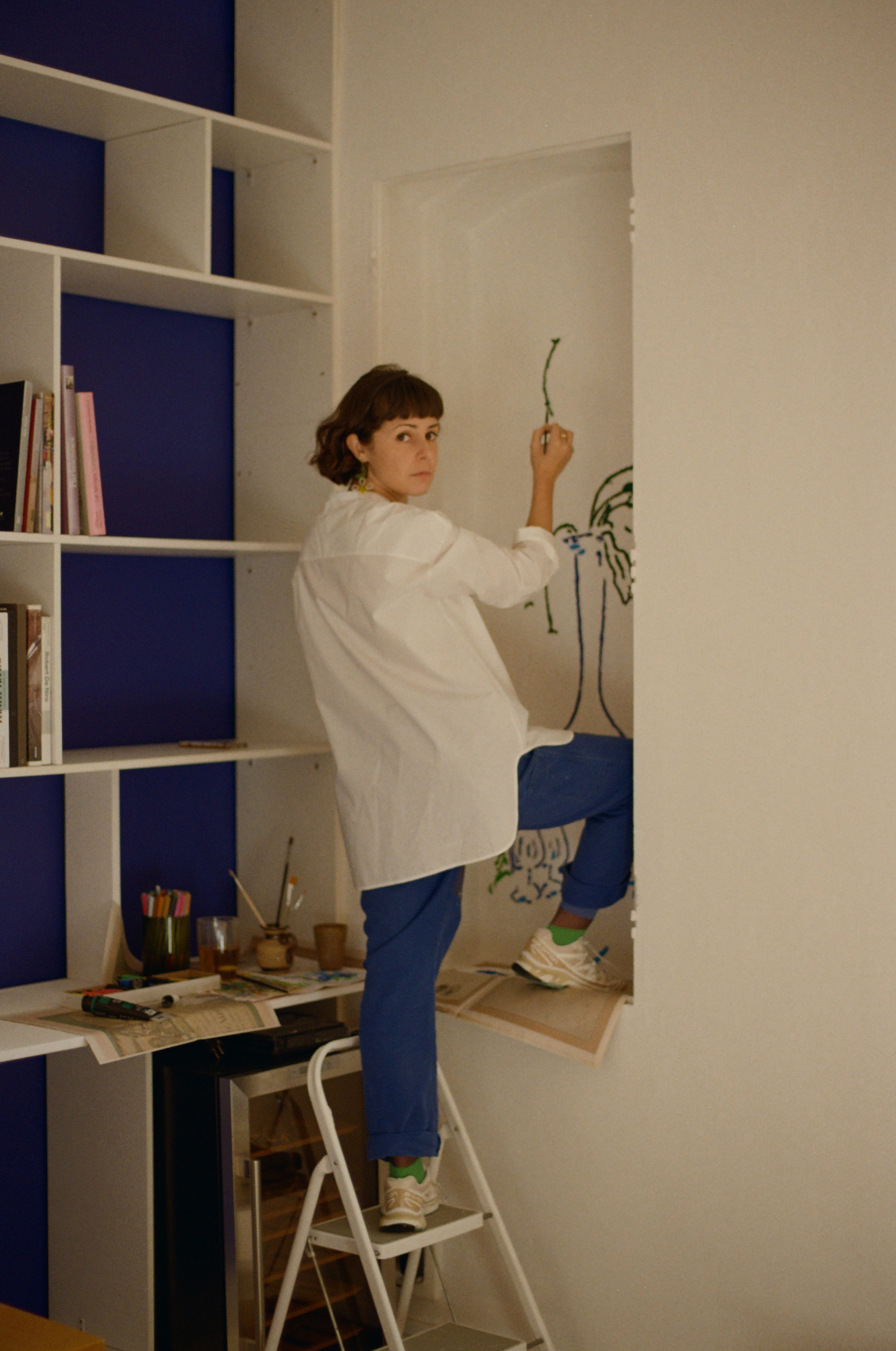
It’s hard to pick just one highest or lowest moment, so here’s a glimpse of a few that stand out. One of my highest moments was having my art show, Before and After Damascus, this past April with Atelier 505. It came shortly after a trip to Damascus, my first in twenty years, which may very well be another high point in itself.
Another incredible high point was collaborating with PARAMAZ, painting directly on their leather. It was such a meaningful moment to work with a brand that shares the same values of traditional craftsmanship, offering their leather for me to paint on, and eventually to have those pieces incorporated into their gorgeous bags. That opportunity was both humbling and inspiring, and it remains one of my proudest achievements.


I’ve also had two particularly low moments. The first was when there was an issue with my carte de séjour during the renewal process. I couldn’t leave the country for months, and after a long period of uncertainty and back-and-forth, I finally received it for ten years, which, of course, became another high point. The second low moment came in Paris, when I struggled to find an apartment. It was an incredibly challenging time, but with the help of friends, I eventually found a solution that worked.
Are there aspects of American life that you long for?
