

I woke up with a punishing headache, the pain spanning my forehead, for the third day in a row. I’m susceptible to migraines, but I knew the source of this pain well: the heat. Despite drinking liters of water, avoiding alcohol, and having a small AC unit in the bedroom (a tool I lived without for two decades, up until last week), they were no match for the 100°F days and ultra-warm nights. At 6 am, as I opened all the windows to let in air while I still had time, the sharp crinkling of aluminum foil resounded in the courtyard; two different neighbors were fastening it to their windows. Two hours later, it was the sound of courage! Buvez beaucoup d’eau! that followed me on a brief walk to move my legs before shutting myself in. I counted five people hauling fresh watermelon and a few who looked steps away from heat stroke. Three irresponsible PR emails came in this morning, suggesting the best spots for ice cream to beat the heat, with no mention of the danger in spending extended time outdoors.

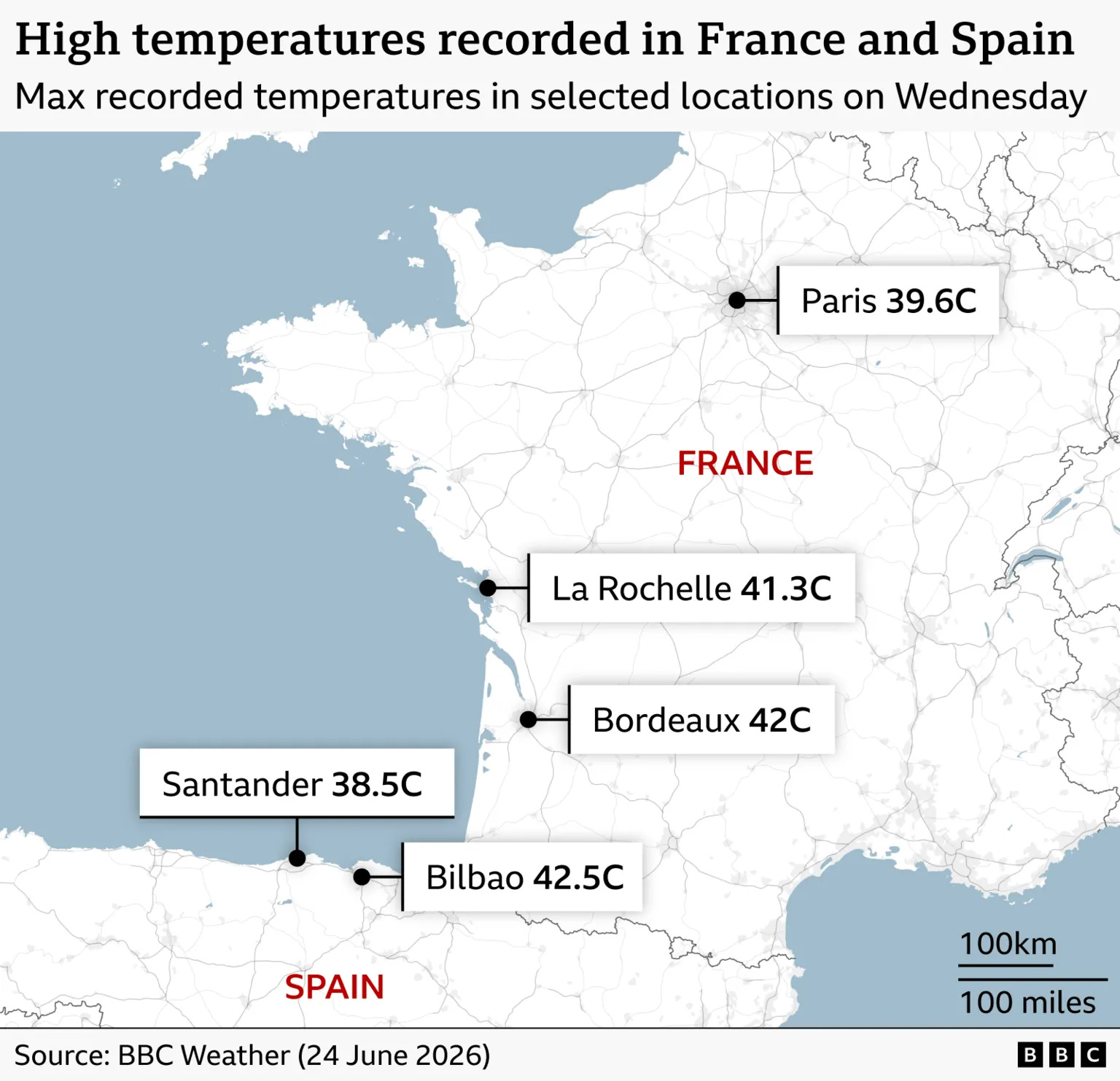
By now, you’ve surely read about the record-breaking temperatures across France or seen apocalyptic graphics on social media. The country has been hotter this week than Mecca. Schools and daycares are closing, trains are being canceled left and right, ER doctors are warning about insufficient cooling in most hospitals, and the debate around air conditioning use rages on. And while it’s perplexing to countries with a long history of AC use, there are reasons for its relative absence in France.
One is a history of relatively predictable summers in northern and central France: mild, with only a handful of genuinely hot days scattered across July and August. A few uncomfortable weeks didn’t justify the massive investment of retrofitting centuries-old buildings with cooling units. Shutters (volets), the traditional French defense against heat, have been useful in getting through those few steamy days. You close the heavy wooden or metal shutters and windows the moment the sun hits the facade to trap the cool night air inside, opening them only after dusk. But that only works when there is cool night air to trap inside. We are way past that now.
On top of this, the French have largely viewed it as an ecologically irresponsible and physically unhealthy luxury. And as Shelby addressed in this very timely piece during the last heat wave at the end of May, there is a pervasive, obsessive concern about drafts and moving air. The relationship to comfort, says Shana Weisberg, is also different.
But these events are not rare. Since the fatal heat wave of 2003, which killed nearly 15,000 people, predominantly elderly living alone, France’s leaders have taken insufficient steps to prepare the country for the current crisis. Dropped proposals, budget cuts to environmental adaptation projects (as recently as earlier this month after the last heat wave, the government cut The Green Climate Fund by nearly 20%), and the inability to accept that our heritage structures need rethinking.
Take Paris: installing external AC compressors or modern solar shading (like shutters or awnings) is strictly regulated or outright banned by Architectes des Bâtiments de France (heritage architects) to protect the city’s uniform aesthetic. And those iconic gray zinc roofs covering 80% of buildings? The material isn’t inherently ill-suited, but given improper ventilation and insulation, the roofs end up absorbing too much heat, turning top-floor chambres de bonne into boilers. Replacing or painting them with reflective white coatings would obviously alter the city’s historic skyline so those in charge of preserving the city’s heritage won’t even consider it. No one will consider condemning top-floor apartments, either, to improve insulation. As my friend Brent Longley, a trained urban planner, said to me this morning, “The city has got to modernize, and that will require letting go of some of its precious attachment to its glorious past.”
Modernizing also means prioritizing the public spaces that are most in need of immediate relief. Last year, El Pais reported that only 7% of public schools — out of around 45,000 nationwide — are equipped with any cooling system to relieve the heat. Those of you who have tried to get around the city in the heat know that very few metro lines or commuter trains have it either. Worse still, doctors have sounded the alarms about overheating hospitals and nursing homes, too. What does the health ministry advise to deal with the brutal heat, aside from hydrating? “To stay home between 11 am and 9 pm, the hottest hours”. How many people can realistically stay home?
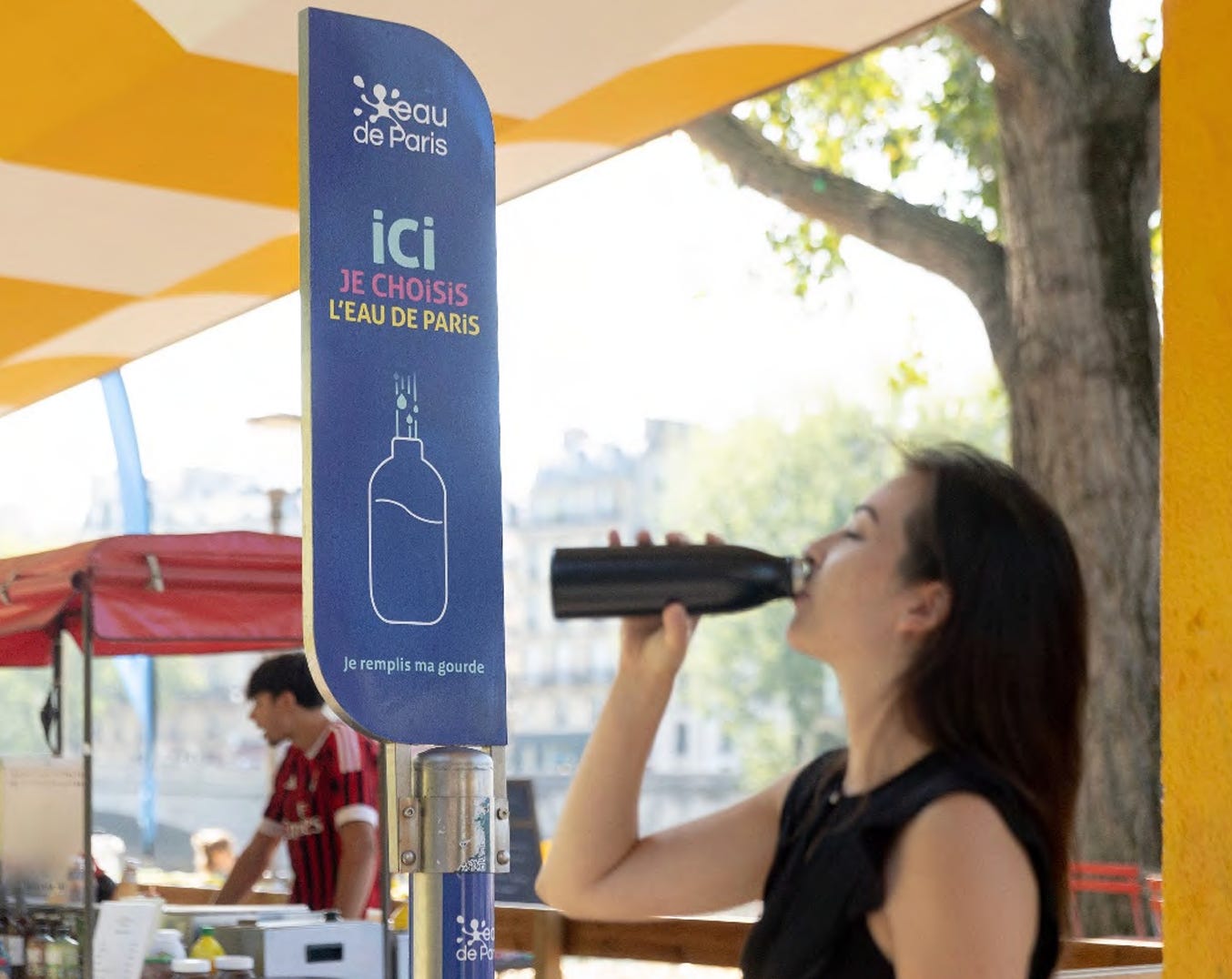
Will this week’s scientific reality check finally be the wake-up call? Do more people need to die throughout the country for that to happen? Does the country need to feel the economic hit it will endure without a real, actionable course of action? Because that’s where we are heading.
Experts predict that measured AC use will be necessary even with the most ambitious mitigation strategies as heat becomes more intense, prolonged, and frequent. I was stubbornly resistant to AC. I have lived with a French engineer for two decades who repeats that while the mobile units cools us down, it redirects our indoor heat onto the streets or courtyard. And I also wanted (still want) to do the right environmental thing. We have shutters on our living room windows that help stabilize the temperature, but only to a point. We live on the 5th floor of an old building with parquet floors. As I write this, it is 31.5°C (89°F) in my living room, a new personal record.
Struggling with a nervous system disorder makes body temperature regulation challenging which is ultimately why, after twenty years, we bought the unit sitting in my bedroom that I use at night. The moral high ground has its limits. Everyone is struggling. Babies, the elderly, the sick, and the unhoused are simply the most vulnerable. The reality now is that this is a public health emergency.
So while air conditioning isn’t the solution, it will ultimately be one tool among many to modify the way we live and work. If France wants to deter individual AC use, it must have clearly designated cooling centers (sorry, misting zones throughout the city are not going to cut it!!) within schools, gymnasiums and various public spaces, already common in the U.S. and parts of Asia. Leaders should be looking to countries like South Korea, Egypt, and Colombia, where innovative solutions have proven successful.
“Public buildings are the priority. That said, AC can save lives in certain apartments. This is also an economic issue: AC is expensive, and access to it is highly unequal. Hence the need to work on collective solutions such as adapting cities, increasing urban green spaces and so on. The question of adaptation is not merely an individual one.” — Researcher and climate scientist François Gemenne on AC, France 24
What’s sad to me is that Paris was innovating in cooling more than 30 years ago. A program established in 1991 by Chirac when he was mayor of Paris has cooled some 900 buildings across Paris. Fraîcheur de Paris is a citywide urban cooling network that uses a 100-km underground piping loop to carry chilled water from the Seine to buildings. (The tech-y bit: it works through closed-loop heat exchangers. The river’s water cools the separate network water before it gets pumped out. The river water and the network water never actually mix.) Chirac wasn’t doing it for the climate but as a practical urban design solution. The city wanted a way to provide air conditioning to major museums, luxury hotels, and department stores without allowing thousands of unsightly compressor boxes to be bolted onto the iconic facades of historic and classical buildings.
If it is only being expanded now, it’s because the network was historically managed under a commercial monopoly designed strictly to cool high-paying, high-density landmarks like the Louvre and major luxury hotels, rather than residential areas. French political parties also prioritized winter heating infrastructure, only rewriting the city’s contracts to mandate a massive public health expansion once severe modern heatwaves proved old stone buildings could become dangerous thermal traps. And here we are.
In a perfect world, come next spring, we will elect the presidential candidate with serious and strategic and actionable plans to make France livable for all as we fight the global climate crisis. Macron has been a failure on this issue (and others we can discuss another day). It is THE issue.
“Our entire society and infrastructure were designed for a climate that no longer exists,” said the climatologist Valérie Masson-Delmotte in Le Monde. Her words should end every political speech, every urban planning meeting, and every debate about whether to bolt an AC unit to a building facade. They don’t yet but let’s hope this week is the turning point.
Thanks for reading! If you think a friend would enjoy The New Paris Dispatch or this series, gift subscriptions are available here | Order copies of my books The New Paris, The New Parisienne, and The Eater Guide to Paris.
We've been experiencing heat in Utrecht, but nothing like that. Our thoughts have been with you folks down south. There were some good articles in Le Monde this morning, but one thing that people have been pointing out is that in addition to mitigation, we need to take serious steps to stop making it worse. At least France has a lot of non-carbon-emitting generation.
The Seine water thing can actually work for both heating and cooling. The Seine is a giant heat sink, so you can dump heat into it in the summer, and you can also draw heat from it in winter. Here in Utrecht we are on district heating, and while it doesn't do cooling at the moment, it certainly can, just as it does in Paris for the Louvre. What that will do to the river ecosystem is of course another question.
Anyway, I know there are still a few more days of this to endure, but I really hope things get better for you. Regarding the air conditioning, your french engineer is correct, but also incorrect: warm air rises, and cool air sinks. So the thermodynamics of your in-window AC are not quite as simple as is being suggested, and you should let go of that guilt! :)
I feel like I've spent the whole week trying to create a general thesis to understand the "wtf" of this heat wave, and you really helped me wrap my head around it. I don't like using our portable AC unit for the same reason you mention. The French version of me is thinking about the neighbors who share our courtyard. But on these 100F days, I'm leaning into the idea of it as one of many tools we can use responsibly.